Real Or Imitaion Vanilla Part 2
From thegoldminer 17 years ago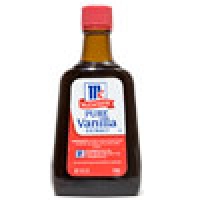
- - to make
- Serves 1
Once again Cook's Illustrated did another taste test to determine which is better or where to use the two types. It is a great magazine and the information is great. Save money and use the imitation for cookies
Ingredients
- McCormick pure vanilla extract shopping list
- or shopping list
- Gold Medal Imitation vanilla extract shopping list
- I found the information about temperatures in cakes and cookies to be the most informative on which to use. Internal cake temps only reach 210 where in cookies are up there at 350 and most of the extra compounds in pure vanilla bake off at 280-300 so real is great for cakes and imitation works for cookies. This makes sense and matters if you do a lot of baking, if little baking, well guess a small bottle of both. shopping list
- Here is a link to winner of the imitation, apparently an east of the Mississippi item and can be mail ordered. I guess I will stick with Tones from Smart and Final. shopping list
- Just an interesting look again into vanilla. shopping list
- http://www.cfsauer.com/products.asp?bid=1 shopping list
How to make it
- Published March 1, 2009. From Cook's Illustrated.
- In the battle of pure versus imitation extracts, could we declare a winner?
- Products tested (listed alphabetically)
- • Adams Pure Vanilla Extract
- • Durkee Imitation Vanilla Flavor
- • Durkee Pure Vanilla Extract
- • Gold Medal Imitation Vanilla Extract
- • McCormick Gourmet Collection Organic Pure Madagascar Vanilla Extract
- • McCormick Premium Imitation Vanilla Extract
- • McCormick Pure Vanilla Extract
- • Morton & Bassett Pure Vanilla Extract
- • Nielsen-Massey Madagascar Bourbon Pure Vanilla Extract
- • Rodelle Pure Vanilla Extract
- • Sauer's Pure Vanilla Extract
- • Spice Islands Pure Vanilla Extract
- In two past tastings of vanilla extract, we reached a conclusion that still amazes us: It matters not a whit whether you use real or imitation vanilla, because you can’t tell the difference when you bake. But at a recent editorial meeting, we took a poll: Did that mean anyone had stopped buying the real thing? No. Our test cooks believed firmly that natural vanilla is the best choice. So we returned to the test kitchen for a definitive tasting.
- In our newest quest for great vanilla, we sampled 12 of the country’s top-selling supermarket brands of vanilla extract, both fake and pure, this time stirring them into milk and pudding before trying a few choices in cake and cookies.
- The Real Deal
- Vanilla is a powerful “flavor potentiator,” meaning it enhances our ability to taste other foods including chocolate, coffee, fruit, and nuts, and boosts our perception of sweetness. While this is true for both pure and imitation vanilla, the choices are far from identical. Scientists have identified around 250 flavor and aroma compounds in real vanilla, while the artificial version has just one: vanillin, the predominant flavor in natural vanilla. Pure vanilla is made by steeping vanilla beans in water and ethyl alcohol, with the exact proportions of each mandated by the government. The beans are expensive, grown on flowering orchid vines in only a handful of tropical countries. They take time and painstaking labor to grow, process, and ship, even before they are converted to extract.
- Imitation vanilla, on the other hand, is a byproduct of paper production or a derivative of coal tar, chemically manufactured through fairly simple and inexpensive processes. Because it’s so cheap, annual global demand for imitation vastly outstrips that for natural vanilla, at 16,000 metric tons to just 40 metric tons for natural vanilla.
- In our supermarket lineup, imitation vanillas cost as little as 18 cents per ounce, compared with up to $4.50 per ounce for natural. In another strike against natural vanilla, most of those 250 flavor and aroma compounds are driven off by high heat during baking or cooking. So if that complex, natural vanilla flavor really can’t be detected, what’s the point of ever buying it?
- To answer these questions, we tested vanilla in a variety of cooked and uncooked preparations. First, we stripped away competing flavors to taste the extracts themselves. Vanilla experts do this by mixing them in milk; we used an 8-1 ratio of milk to vanilla. Tasted this way, real vanilla extracts clearly won the day. Their greater complexity shone through, with testers detecting everything from notes of honey and maple to licorice and prune.
- In this case, imitation vanillas all fell to the bottom half of the rankings. Tasters said they had a strong, pleasing aroma, “like vanilla cookies that have already been baked,” but little vanilla flavor and a taste that was bitter and medicinal. More research revealed that imitation vanilla is known to taste harsh if too much is used—which helps explain our tasters’ reaction.
- But you would never use vanilla extract in such a heavy concentration. So we sampled them again, in vanilla pudding. Now the ratio of dairy to vanilla was a whopping 56 to 1. Our recipe adds vanilla extract at the end of cooking, off the stove, to help preserve its flavor. Despite this precaution, many of those distinctions we had noted among vanillas in the milk tasting were dimmed. Some aroma and flavor still may have been driven off by the warmth of the cooked pudding and muted by the eggs, butter, and sugar. Our results shuffled, but only slightly—except for one imitation extract that shot from seventh place up to the top of the ranking.
- One of the most striking differences between pure and fake vanilla involved alcohol flavor. While federal guidelines require 35 percent alcohol in pure vanilla extract, there’s no minimum for alcohol in imitation vanilla, and manufacturers have an incentive to use as little as possible to make synthetic vanillin soluble: If they use more, it costs more to make. This explains why tasters kept describing real vanilla as “boozy,” an adjective rarely applied to fake vanilla. But they also found the real stuff nutty, spicy, and more complex.
- The Heat Is On
- Real vanilla’s advantage in milk and pudding was clear, but most of time, we’re using vanilla extract in cookies and cakes. To help our tasters focus, we limited our baked-goods tasting to just three samples. After averaging the scores from the milk and pudding tastings, we chose the top-ranked pure vanilla, the highest-ranked imitation, and the bottom-ranked imitation. If tasters couldn’t tell these three vanillas apart in baked goods, we knew the game was up; it really didn’t matter. We baked three yellow cakes and three batches of vanilla cookies—and waited.
- To our surprise, each recipe showed two distinct outcomes. In cake, the pure vanilla came out on top but just a hair ahead of the high-ranking imitation. In cookies, the pure vanilla dropped to last place, and that high-ranking imitation soared to first place. As it turns out, flavor and aroma compounds in vanilla begin to bake off at around 280 to 300 degrees. Cakes rarely exceed an internal temperature above 210 degrees; cookies become much hotter as they bake. As a result, pure vanilla kept a slight flavor advantage in the cake—but not in the cookies.
- Tasters’ Choice
- So what’s our conclusion? If you’re only buying one bottle of vanilla for cooking, baking, and making cold and creamy desserts, our top choice is a real extract. If you only use vanilla for baking, we have to admit there’s not much difference between a well-made synthetic vanilla and the real thing. Speaking to pastry chefs, we learned that many buy an arsenal of vanilla extracts, using cheaper imitation for baking and pure for confections made with moderate or no heat, such as puddings, pastry cream, and buttercream frosting.
- In the test kitchen, we go through so much vanilla extract that we buy it in bulk. So we’ll be ordering our winner by the case. We also recommend our top-rated imitation vanilla for its “mild and gentle” vanilla flavor.
- The winners are:
- McCormick Pure Vanilla Extract
- This vanilla won top praise for being “strong,” “rich,” and “spicy,” with a “sweet undertone.” It had “clear vanilla flavor with nice balance” and notes of “dried fruit,” “caramel,” and “chocolate,” “like Kahlúa or Bailey’s.” In pudding, it was deemed “a step above,” with an extremely “pleasing finish.”
- Another Recommended Pure Vanilla Extract was indeed:
- Rodelle Pure Vanilla Extract
- “Smoky” and “earthy,” with “caramel,” “prune,” and “chocolate” notes, it was praised for offering “deeper, richer ‘bass tones’ of flavor.” Prepared in pudding, it was “subtle,” a “gentlemanly vanilla: well-balanced, mature, a suggestion of alcohol and smoke.”
- Gold Medal Imitation Vanilla Extract
- Tasters felt that this imitation vanilla ranked with the pure extracts. “Lovely, seemed like pure vanilla,” said one; another described it as “mild and gentle; maybe it’s not real, but it tastes good.” Others said it was “perfumy,” with notes of “toasted rice” and “buttered popcorn.”
People Who Like This Dish 3
- juels Clayton, NC
- jett2whit Union City, GA
- bakermanrooster Wichita, KS
- minitindel THE HEART OF THE WINE COUNTRY, CA
- thegoldminer Sacramento, CA
- Show up here?Review or Bookmark it! ✔

The Rating
Reviewed by 3 people-
Great info here, thanks, JJ!
 juels
in Clayton loved it
juels
in Clayton loved it
-
I have found that Mexican vanilla is really good. Some friends went and brought me back a big bottle that lasted a long time. Thanks for this info.
 jett2whit
in Union City loved it
jett2whit
in Union City loved it
-
wow jj thanks for the good info here
tink minitindel
in THE HEART OF THE WINE COUNTRY loved it
minitindel
in THE HEART OF THE WINE COUNTRY loved it
The Groups
- Not added to any groups yet!
Reviews & Comments 7
-
All Comments
-
Your Comments
" It was excellent "
" It was excellent "
" It was excellent "