San Diego-style Blue Corn Salmon Tacos With Orange-habanero Hot Sauce
From orangeskipper 18 years ago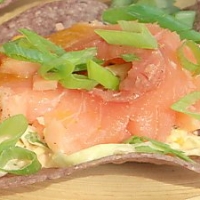
- 40 minutes to make
- Serves 12
Courtesy of Bobby Flay. This one's a classic in my book.
Ingredients
- 3 cold-smoked salmon fillets, 8 ounces each shopping list
- canola oil shopping list
- salt and freshly ground black pepper shopping list
- 1/4 head green cabbage, finely shredded shopping list
- 2 green onions, thinly sliced shopping list
- 1 cup best-quality mayonnaise or veg equivalent shopping list
- 1 tablespoon chipotle pepper puree shopping list
- 1 tablespoon fresh lime juice shopping list
- 1/4 cup finely chopped fresh cilantro shopping list
- 12 fried blue corn taco shells shopping list
- orange-Habanero Sauce, recipe follows shopping list
- Preheat grill or grill pan over high heat. shopping list
How to make it
- Brush salmon with oil and season with salt and pepper. Grill on each side for 3 to 4 minutes.
- Let cool slightly and shred the meat with a fork. Place in a bowl with the cabbage and green onions.
- Combine the mayonnaise, chipotle and lime juice in a small bowl and season with salt. Add the mayonnaise and the cilantro to the salmon mixture and gently fold to combine. Season with salt to taste, if needed.
- Divide the salmon mixture among the taco shells and drizzle each with the Orange-Habanero Sauce.
- ********Orange-Habanero Hot Sauce:
- 6 cups fresh orange juice
- 1 habanero chile
- 1 tablespoon honey
- Salt
- Place juice and habanero in a medium nonreactive saucepan and cook over high heat until reduced to 1 cup, stirring occasionally.
- Remove the habanero, whisk in the honey and season with salt.
- Let cool to room temperature before serving.

The Rating
Reviewed by 11 people-
These sound incredible, going to have to try these for sure. Great post
 chefmeow
in Garland loved it
chefmeow
in Garland loved it
-
WOW!! This sounds killer. Especially the Orange Habby sauce. Its only 9 am and this recipe is making me hungry... LOL I had planned on smoking some salmon this weekend. Not cold smoked though. The texture wont be quite the same but I would think it...more
 jimrug1
in Peoria loved it
jimrug1
in Peoria loved it
-
You got me going with just "San Diego"!!! My favorite place in the US. This recipe sounds delicious. I must admit I have a lot to learn. What is a "non-reactive" pan? Thanks for the post. Marcia
 mao65
in Griffith loved it
mao65
in Griffith loved it
The Groups
-

Health Food Junkies
425 members -

Suggestions
1018 members -

Tips And Advice
497 members -

MEXICAN FOOD
429 members -

Fresh Food Cooking
120 members -

Spanish And Hispanic Food
142 members -

Onion Junkies
100 members -

No Sugar Low Sugar Cooking
94 members -

Anything Goes
294 members -

THE COMPLAINT DEPT
158 members
Reviews & Comments 12
-
All Comments
-
Your Comments
" It was excellent "
" It was excellent "
" It was excellent "
" It was excellent "
" It was excellent "
" It was excellent "
" It was excellent "